

September Full Moon: Sumac Chicken (Musakhan)
Harvest, fire, release

As summer comes to a close and a chill enters the air, the leaves are beginning to change colors on our mountainside and I hunger for more hearty autumn meals. The shift of seasons harkens me back to autumns past, and I remember fall camping trips, cozier clothing, and one of my favorite things: outdoor cooking over an open fire. Today is the Harvest Moon, and this year as I root more deeply into the place that is my home, I’m deepening my relationships to the plants that grow wild in my neck of the woods. Creating recipes from wild foods connects me to my local landscape and makes me part of this thriving ecosystem. I learn from the plants around here as I observe, and I hope to create lasting family traditions with recipes that are born from the seasonal wild offerings of this place we call home.
When a plant or animal is considered invasive, it takes over and is detrimental to the native populations of fellow plants and animals. It colonizes the homes of native species, siphons resources, or destroys the local environment. Some plants and animals that are not native, however, form a symbiotic relationship with the native populations and rather than taking over, they offer food and medicine to the local populations and don’t choke out the native populations. They live in harmony, integrate into their new homes without inflicting harm on local populations, and they are considered “naturalized.”
Wild Sumac, or more specifically, Staghorn Sumac, is a native plant that grows abundantly in the Northeast, and there is plenty of it around our mountainside. I see its characteristic deep red clusters or bracts all along the roadsides and we have a volunteer Sumac plant growing in our garden. Sumac has been on this land for thousands of years and is supportive of native wildlife, birds, and insects. Some accounts tell of stories of indigenous peoples making sumac lemonade, a tart, vitamin-rich drink whose acidity comes from sumac and not actually lemons.
Concurrently, the plant has grown natively in the Middle East or Cana’an for thousands of years and is an inextricable part of Arab cooking. Its signature deep red color and pronounced tartness add a visual and flavor dimension to so many of my family’s Arab recipes, and it’s also a key ingredient in za’atar. You can find sumac in fattoush and all sorts of salads and types of mutabal.
One of Palestine’s most famous dishes is musakhan. Dubbed Palestine’s national dish, the sumac-rubbed roasted chicken with caramelized onions, olive oil, taboon bread, and toasted nuts is special for its connection to the land. And as I work to right my relationship to my diasporic home of several generations which is not my ancestral land, I seek to cook food that is in harmony with the land I live on so that I may live in harmony with my co-inhabitants, naturalized rather than invasive. I’ve been noticing Staghorn Sumac everywhere and it has been calling to me, a parallel point of connection to the cooking of my ancestral lands.
Although there are many varieties of Sumac, including perhaps the most well known poison Sumac, the poisonous variety has white berries and not the fuzzy red horn-shaped clusters of berries that you harvest for the sour punch. Because staghorn sumac is often misunderstood as a poisonous plant, it can be treated as a weed and eradicated because of this misunderstanding.
From Serious Eats:
“... the neighboring farm lets me clip off fruit clusters from their sumac trees, but the farm manager anxiously rushes over to warn me that "those trees are the most poisonous plants in the country!" We tell him that poison sumac has white clusters and not red, and since that is the only part of the tree we are after, there is no chance of mistake. He still looks at us skeptically and shrugs—"Don't say I didn't warn you." In fact, many a sumac grove has been mistakenly knocked down in the belief that it is poisonous.”
This story makes me think of harmful beliefs about immigrants and diaspora communities that are dominating headlines due to the xenophopic government officials and political candidates. Like plants, people can also arrive as invasives - but even more insidious than any plant or animal. The worst offenders came with a genocidal rampage, employed chattel slavery, and to this day, continue to destroy the Earth and water supply, dumping chemicals into the air and environment. And then many communities who arrive from a diaspora can act like naturalized plants do in service to their ecosystems- tending the Earth, creating thriving communities and working in defense of the land and all of her inhabitants. We decide which ones we will be.
Although I set out to draw a parallel between how Sumac may have come and naturalized, I ended up being wrong and it’s actually native itself. But similar to the Sumac that grows in the Middle East, our North American variety can also be foraged and made into a sour-tangy powder to add to all sorts of dishes. Today we will be making a riff on the Palestinian dish, musakhan, Sumac-spiced chicken and onions, but with wild ingredients local to my diaspora home in the Catskill Mountains. Sumac is everywhere here, thriving in the medians between highway lanes, their bright red bracts in stark contrast to the sea of green. As autumn falls, their leaves also turn bright red.
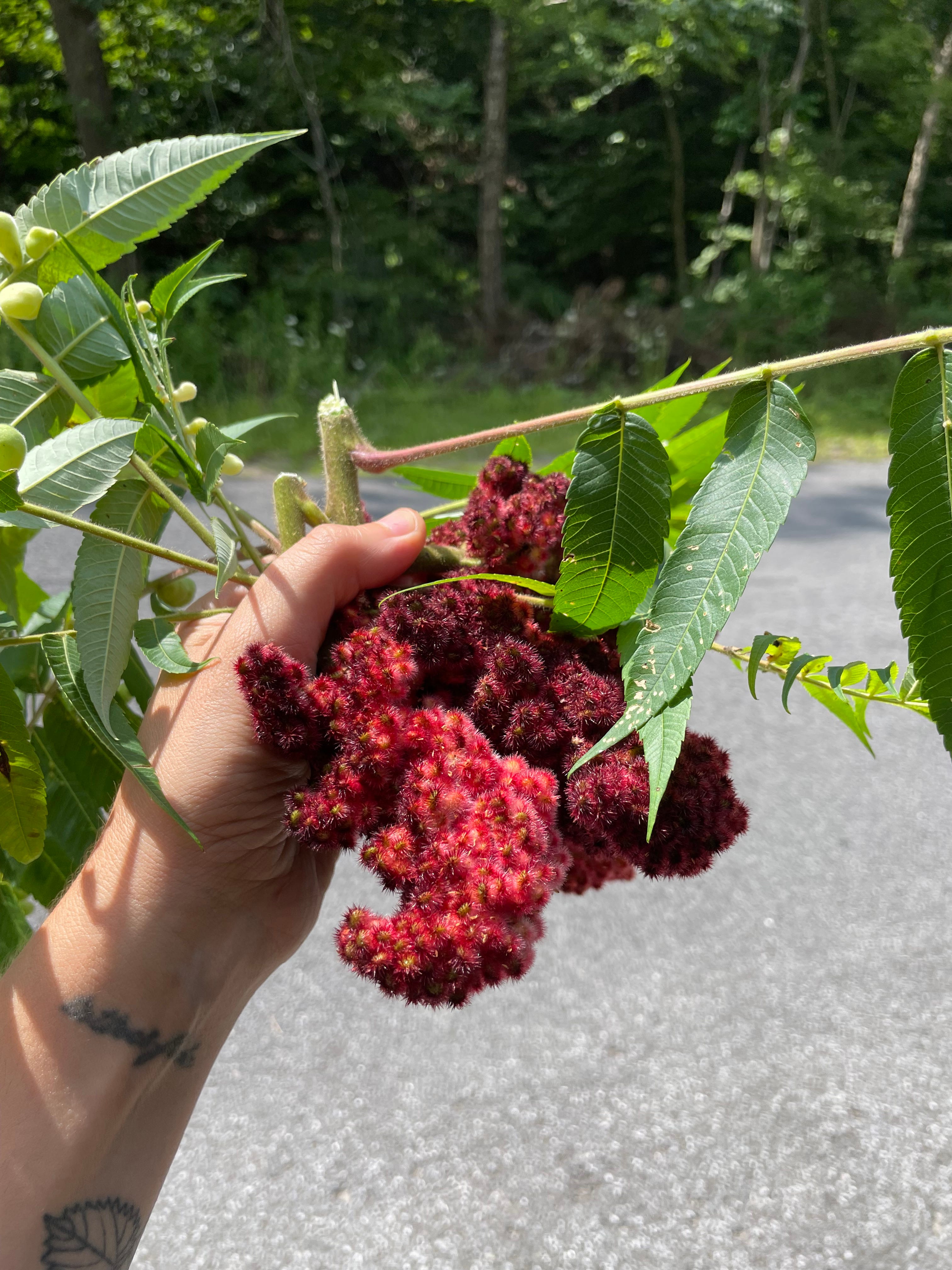
Staghorn Sumac is best harvested when it ripens and before heavy rainfall which washes off the citric acid which gives it its sour punch. If you’re not sure, taste a bit before harvesting the entire bract. Once you have the bract, hang it up on a line (in a dry spot, covered from the rain) to dry fully. After drying, break up the clusters of berries, put them in a blender for a few pulses, and pass them through a medium-fine mesh strainer. This will allow you to collect the citric red powder without the large seeds. Make sure it is fully dry before storing in an airtight jar.
In addition to the succulent chicken, the deeply caramelized onions are what really make this dish shine. They take some time to make correctly, but the time it takes to alchemize a harsh raw onion into a jammy, sweet soft bed of caramelized onions is well worth it. I have been buying local onions from the farm near me and they are dense, hard, and packed with flavor. I slice the ends off, halve them, and slice the onions thinly. Though I may have developed somewhat of an immunity to my eyes tearing up from cutting onions because I cook with them every day, these farm onions are sharp and potent and my eyes just well up with tears.
I decide to lean into it and allow myself a deep, full cry, because my body yearns for one. I’ve been taking in so much terror and have not been able to release the traumas sitting in my emotional body, so when I physically begin to tear up from the onions, the floodgates open. First, I cook the onions in some olive oil and a little salt on medium-high, until they turn translucent and sweat a bit. My own tears expel some cortisol I’ve had building up. Then, slowly, as the onions begin to brown, I lower the heat and stir them every couple of minutes. It takes about 25 minutes to finish cooking them. Watching the transformation of the raw onion into a silky, glistening sweet texture, I’m reminded of the necessity to feel through our emotions so we can come out the other side with our tenderness and humanity intact. If you rush this step, you end up with burnt, bitter onions.
“Musakhan is an ode to the fellaheen-- the farmers, harvesters, and cultivators of Palestinian land-- and a tribute to the olive tree, which has a special place in our cuisine and heritage. Under Israeli occupation, authorities have uprooted more than 800,000 olive trees, some centuries old, and taken the land beneath them, politicizing the very ingredient that makes this dish so special.” - Reem Assil, in an excerpt from her stunning book, Arabiyya
The heat from the fire and the time spent tending it, alchemizes something harsh into something sweet and tender. I have hope that we will see a future filled with more tenderness and far less brutality. But it’s up to us to engage in daily practices to hold on to our humanity. With each painful transition we live through, we have the ability to see it through and get stronger and more connected, or to let it sour us and get bitter. We must find avenues of release so that we can move forward as we keep building the movement for global solidarity.
////////////////
Recipe:
Sumac Chicken with Caramelized Onions (Musakhan)
You’ll find many versions of this recipe, and this one is a variation of the more traditional serving with taboon bread. Since I can’t find taboon bread near me, when I don’t have the time to make it, I like to serve this chicken with rice. When you spoon the chicken fat and caramelized onions over the rice, it rounds out a decadent comfort meal. Serve with lemony garlicky bitter greens if you’d like.
Ingredients:
1 whole pasture-raised chicken
¼ cup olive oil, divided
3 tbsp sumac
1 tbsp allspice or seven spice
2 tsp salt
1 lemon
3 large yellow onions
2 cups long grain rice
½ cup sliced almonds or pine nuts
Instructions:
Preheat the oven to 300 degrees F. Meanwhile, prepare the chicken.
First, quarter the lemon and one of the onions. Then season the chicken liberally with sumac, allspice, and salt. Drizzle with olive oil and rub all over the skin and inside the cavity. Stuff the bird with the quartered onion and lemon, and truss the legs with butcher’s twine.
Bake the chicken on a rimmed baking sheet or in a casserole dish for 3 hours.
Slice the remaining onions thinly, and add to a large pan with a drizzle of olive oil. Cook on medium-high heat for about 5 minutes, stirring frequently, until the onions start to brown, then reduce heat to medium-low and continue to stir every minute or so, until they completely soften and turn jammy, 20 minutes more.
Prepare rice and serve with chicken, caramelized onions, and a scattering of nuts.
//////////////////
Spell:
Cleansing fire and release
As the leaves begin to turn colors and release from their trees, take a cue from the natural world around us and identify what needs to be released and composted for us to root into the Earth a little deeper, and prepare for the autumn and winter of rest. What activities or projects are a little too much to handle and might be sapping your energy? Although summer may be a time for a rush of activity and growth, this season marks the time to begin to slow down again. Now is the time to identify the elements that need to be released. Make a small fire and either literally (after writing them down on pieces of paper) or figuratively burn away the identified elements you need to release this season.
Resist the urge to fill that space with something else. Sit with the slowness and allow it to inform what comes next. Be careful not to rush things. By filling the void constantly, we don’t allow ourselves to deeply feel our feelings or sit with our feelings. Take this time to honor whatever feelings come up for you. If you need to release it all with a nice deep cry, go for it.